 | Language :
DIP Switch
Through-Hole DIP Switch
The Hardware "Configurator" for Embedded Systems
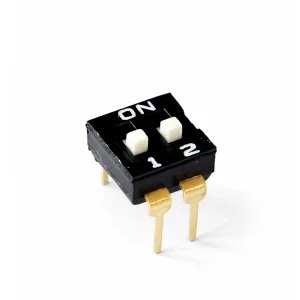
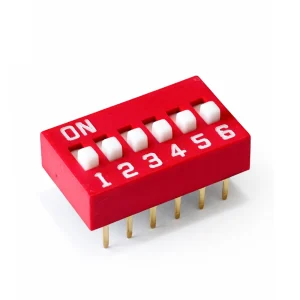
A DIP Switch (Dual In-line Package Switch) is a manual electro-mechanical component consisting of a series of tiny, individual switches housed in a single unit. The Through-Hole (THT) variant is designed with pins that pass through the PCB, providing high mechanical strength and compatibility with traditional wave soldering processes.
Commonly referred to as "hardware jumpers," DIP switches are used to set permanent or semi-permanent configurations—like device addresses, communication protocols, or security codes—without needing software or a user interface.
| Feature | Details |
|---|---|
| Pitch (Spacing) | Standard 2.54mm (0.1") |
| Positions | 1 to 12 positions (commonly 2, 4, 6, 8, or 10) |
| Switch Type | SPST (Single Pole, Single Throw) per position |
| Mounting | Through-Hole (PCB Pins) |
| Contact Rating | 25mA to 100mA @ 24V DC |
| Materials | Heat-resistant thermoplastic; Gold plated contacts |
| Durability | 1,000 to 5,000 cycles (Designed for infrequent setting changes) |
Common Actuator Types
Through-hole DIP switches are categorized by how the user interacts with the tiny sliders:
Slide Type: The most common variety. A small plastic slider moves left/right or up/down to bridge the contacts. Available in "raised" (easy to flip) or "recessed" (requires a tool, prevents accidental changes) versions.
Why Choose Through-Hole Over SMD?
Mechanical Stability: Because the pins are anchored through the PCB, THT DIP switches can withstand significantly more force than surface-mount versions. This is critical for industrial environments where users might use a screwdriver or pen to toggle the switches.
Prototyping Friendly: THT pins are perfectly spaced for breadboards and "perf-boards," making them the go-to for hobbyists and R&D engineers.
Ease of Inspection: Solder joints on the underside of the board are easy to inspect visually or with Automated Optical Inspection (AOI).
Common Applications
Industrial Automation: Setting Modbus or CAN bus slave addresses on PLCs and sensors.
Garage Door Openers: Hard coding the RF security frequency between the remote and the motor.
Computing: Selecting "Master/Slave" modes on legacy hard drives or setting CPU clock speeds on older motherboards.
Telecommunications: Configuring baud rates and parity settings on RS-232/485 converters.
Security Systems: Designating zones (instant, delayed, or 24hr) in alarm control panels.
DIP Switch
-
DIP Switch
Low Profile DIP switch
-
DIP Switch
Standard DIP switch